

When Law Consumes Creativity
How Legal Systems Devour Themselves Through Creative Cannibalization - The Judicial Mathematics of Prosecutorial Overreach

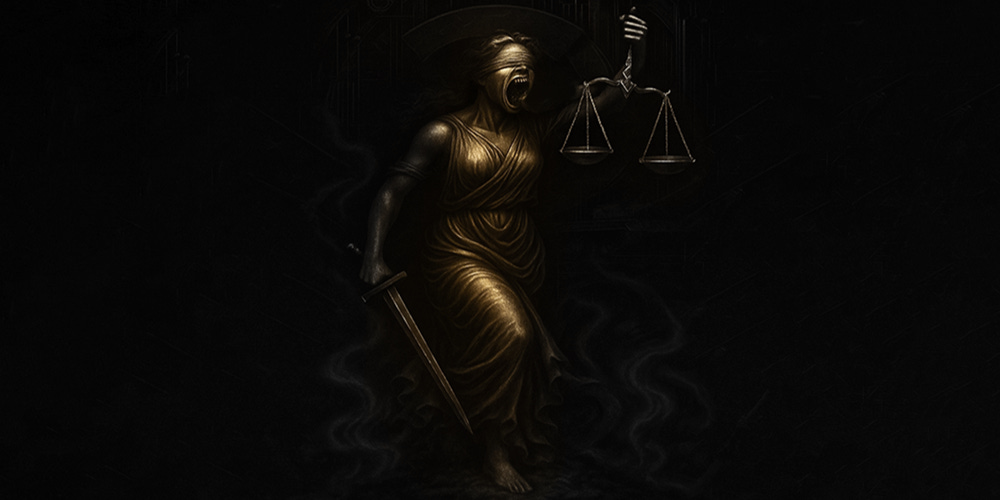
When Law Consumes Creativity
In recent decades they´re has been an intensification of action against those who create, publish, or share satirical or critical expression while paradoxically the creation and publishment of satirical or critical expression is expanding through A.I. and Meme Culture. The phenomenon is global, spanning authoritarian regimes, hybrid states, and democracies.
Satirical expression, historically recognized as discourse, has become a centerpiece for criminal, civil, and administrative law, producing a legal inconsistency and escalating risk for creative actors.
The framework of law, designed as a shelter, has become of a source of interpretational inconsistency. Legal systems designed to protect democracy have evolved into mechanisms that consume the very uncertainty. What was once a field for playful, critical, or even scathing negotiation with authority now resembles a minefield, invisible boundaries seem to be shifting.
Bureaucratic systems, powered by fatigue and system inertia tend to escalate their interventions not out of measured necessity, but out of reflex, out of institutional muscle memory.
Cartoon Carnage
The prosecution of satirical artists is no longer a statistical aborration or a symptom of transition, but rather a form of governance against the population. The mechanism of disciplinal punishment is indifferent to the nuances of humour or intent. What matters is the public performance of neutralizing the visiblity of the unwillingful actor.
Satirical output was always liable to reinterpretation, but as authorities pivot from toleration to prosecution in response to shifts in mood, dependence, or institutional convenience it can becomes of danger.
No artist can automatically assume when and if the boundaries will move, which gesture or act will become reclassified as late criminal, or which audience’s outrage will be future wise instrumentalized. The content of the work matters less than its potential for future ambiguity.
The system projects power by selecting not the most harmful, but the most unpredictable, as its target. The cartoonal carnage is not about content, not about danger, but about control, about discipline.
The artist walks in a labyrinth not just of the law, but of interpretation, never knowing when the grounds can shift.
In the past they´re has been, even in democratic societies like the for example the UK, Germany, Spain, and Belgium actions against satirical and flagged satirical behavior, prosecutors have targeted high-visibility satire in the past, treating it as a threat on par with crime or acts of terrorism.
Overworked, professionally exhausted prosecutors display higher rates of punitive escalation. The very publicness of satire multiplies risk, creators can be punished not for their actual harm but as a central feature of how authority polices discourse.
Satirical works, whether a cartoon, meme, or video, are exposed to unpredictable retroactive judgment.
How Legal Systems Devour Themselves and Everyone Else in Their Path
Prosecutorial logic in satirical cases can be impersonal, mechanistic, and ultimately self consuming. Every prosecution, no matter how trivial, is validated and judged by the one that came before. The machinery acts self justifying, to preserve order and generate a etiquette.
In its most refined forms, the system does not only punish but deletes, suspends, bans, designates.
The violence is procedural, administrative, and routinely. The suppression is not exceptional, but a function of the ordinary operation of law.
Imagination is not simply policed, nor the Trial, not the outcome, it is the penalty.
Prosecution cannot be measured as justice in compensated spectacles. The system is designed to process, not resolve. Each prosecution of satire is also a small act of cannibalization further democratic rights.
In its most extreme forms, the system suffocates not only individuals but the very possibility of imagination. A single preventive ban, a deletion order, a blacklisting, enacted without malice, almost as afterthought erases a future before it can even begin.
The Absurd Judicial Mathematics of Satire Prosecution
The metrics of prosecution do not align with the logic of harm or justice, but with the need to discipline unpredictability.
Satire was always vulnerable to literal interpretation.
Legal logic can be inverting. Research on past prosecutorial behavior reveals, that escalation is systematically favored, in high visibility cases.
The “visibility trap” has an effect, satirical creators, necessity operating in public, attract more aggressive prosecution than coventual offenders. Media attention increases the perceived political value of prosecution, making artists primed targets for prosecutors seeking advancement.
The calculus of legal risk around satire is a mathematics of the absurdal. Bureaucracies mobilized not against demonstrable harm but against potential, perceived, or symbolical forms of transgression.
No artist will ever anticipate which moment will become their undoing. Law becomes a flexible weapon, its sword can be sharpened by institutional paranoia. The more surprising or contagious the joke, the greater seems the risk of future jugmentality.
What cannot be tolerated is criminal intent and logically forms of erosion of national authority.
Legal logic in satire prosecution is often self defeating. It prioritizes control over narrative and perception.
The effect is immediate and willingful, artists self censor, diluting their work of potential to avoid being in the crosshairs of a system that thrives on selective outrage. This dynamic creates a paradox where satire, meant to provoke thought and expose absurdity, can itself sometimes become illogical, mirroring the very systems it critiques.
By bending under pressure, artist risks losing their creativity, trapped in a cycle where the fear of prosecution hinders artistical creation.
The judiciary is also damaged in this process, as its censorship of expressive potential erodes the very legal principles and expressional interpretation of legal laws.
With the prioritizing of control narratives over clarity, the integrity of laws meant to protect freedom, replaces justice with a performance, hindering future expressionism.
The Process as Punishment
Fear spreads quietly, but effectively. Artists and others learn to shrink, industries pivot to safety, communities practice self censorship as an ethic of survival. What began as targeted discipline metastasizes into cultural approval.
Creators, journalists, and cultural workers who particulate in long term self censorship or withdraw from public expression in direct proportion to prosecution risking that the state itself become of brain drain and long term loss of creative capital.
Democratic and semi-democratic systems that rely on uncertainty and critique for renewal now suffer from self imposed intellectual and cultural stagnation.
Authority may survive, but imagination will not. The systems that eat their creators also eat their own capacity for internal renewal and adaptation, sowing the seeds of their own consumption.
Key Points
Artistic freedom violations, especially targeting satire, have become a normalized feature of contemporary legal governance rather than an occurrence.
The boundaries of permissible satire can be too undefined and are often enforced retroactively, generating fundamental legal uncertainty for creators.
Laws originally intended to preserve order or protect reputation are redeployed as tools to punish creative unpredictability.
Satirical expression is uniquely vulnerable to legal misinterpretation and weaponization, often due to its inherent ambiguity and public resonance.
The intent of the satirical artist is typically disregarded by prosecutorial and judicial actors, who instead privilege prevailing power structures or bureaucratic intentions.
Artists can face legal risk not for the explicit content of their work, but for its ambiguity, reach, or potential for virality.
Exhaustion and overwork within the legal profession are linked to punitive escalation and a normalization of repression.
Bureaucratic decisions to censor or prosecute satirical work have become routinized, reducing protection for creative freedom.
Public figures, despite their theoretical exposure to criticism, are shielded by vague legal justifications and overbroad interpretations.
Self censorship is widespread among artists, journalists, and academics, as the threat of punishing processes is often a more powerful deterrent than the law itself.
Resource allocation within legal institutions is distorted, as energy is expended on prosecuting satire rather than harmful conduct.
Judicial reasoning in satirical cases routinely fails to account for the unique formal and social functions of satire, instead treating it as literal attack.
Administrative controls such as bans, deletions, and designations are increasing over explicit legal prohibitions, mirroring authoritarian modes of censorship.
The chilling effect of prosecution is not limited to individuals but propagates exponentially through creative networks and entire professional fields.
Brain drain of artists and satirists fleeing aggressive prosecution constitutes a loss of cultural and intellectual capital for societies.
Ritualized prosecution teaches creative communities to fear uncertenty and suppress innovation, limiting the imagination.
Legal processes become public rituals that reinforce social boundaries, often to the detriment of creative and discursive renewal.
The broader damage to cultural innovation, public debate, and institutional legitimacy is neither measured nor remedied within existing frameworks.
Authority and stability are preserved in the short term, but at the cost of adaptability, creative diversity, and public trust.
The law is increasingly weaponized in long term warfare acts
Even legal systems originally structured to protect artistic and discursive pluralism can become paralyzed under escalating prosecutorial logic.
Satirical prosecution emerges as a symptom and an accelerant of democratic erosion, signaling systemic vulnerability and in long term a cultural and institutional decline.